
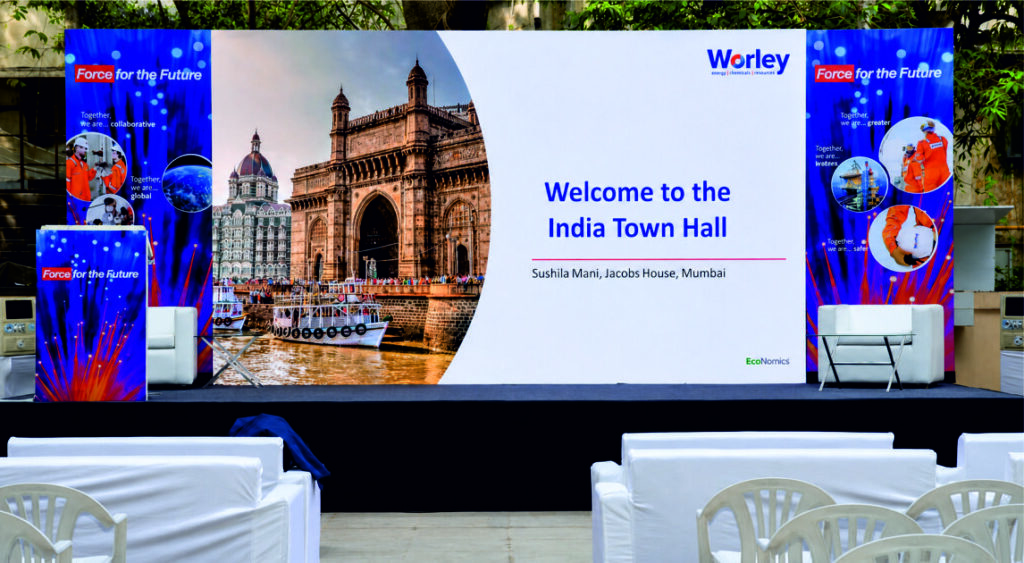
What Annual Corporate Townhalls Actually Require — A Production Guide for Mumbai HR Teams
By Shalinie Gill, Co-founder • MRG Evennts
Annual corporate townhalls look deceptively simple. A leadership team, a screen, a microphone, two or three hours of business updates and Q&A. Most HR and Corporate Communications teams approach them as scaled-up meeting management.
They rarely are.
An annual townhall for 500 to 2,000 employees inside a corporate office or auditorium is one of the more technically demanding event formats in the corporate calendar. The production constraints are higher than a hotel conference (limited rigging, fixed power, no spare technical bandwidth), the content density is higher than an annual day (every minute carries information, not entertainment), and the consequence of failure is more public than most events (the entire workforce experiences any production stumble simultaneously).
This guide is a senior production perspective on what these townhalls actually require — the decisions HR teams underestimate, the technical realities of in-office production, and the role split between the HR/Comms team and a production partner.
Why In-Office Townhalls Are Harder Than Hotel Events
Production teams that primarily deliver hotel conferences often underestimate in-office townhall production. The reasons are specific:
Fixed infrastructure. A hotel ballroom is designed for event production — rigging points, three-phase power, climate control, sound damping. A corporate auditorium is designed for occasional use, with whatever the company chose when the building was built. The production team works within those constraints rather than designing around them.
IT and security coordination. Hotels have their own technical infrastructure independent of any client. Corporate offices have IT teams, security protocols, network segmentation, and physical access restrictions. Every cable, wireless device, and recording setup needs IT clearance — sometimes weeks in advance.
Recording and distribution requirements. Most annual townhalls are recorded for distributed teams who could not attend live. The recording quality must be professional. The distribution format (internal MP4, intranet streaming, archived video) is dictated by the client’s existing systems, not the production team’s preferences.
Audience density. A 1,500-person townhall in a corporate auditorium is a higher density per square metre than the same audience in a hotel ballroom. Sound coverage, sightlines, and crowd flow all need calibration for the specific space.
None of this is unsolvable. But pretending these constraints do not exist is how townhalls fail in ways the audience notices.
.
The Five Production Decisions That Determine Whether a Townhall Works
From 15 years of corporate event production, the decisions that distinguish a well-run annual townhall from a stumble are remarkably consistent. Here are the five that matter most.
1. Audio coverage, not stage spectacle
The single biggest production failure in townhalls is uneven or distorted audio. An employee in row 24 should hear the CEO with the same clarity as an employee in row 4. This is a sound design challenge, not a microphone choice. Speaker placement, delay timing, room acoustics, ambient noise — all need engineering before the first speaker tests their microphone.
Stage spectacle (LED backdrops, dramatic lighting, video walls) is often what production budgets default to. None of it compensates for inaudible audio. Audio first, visuals second.
2. Camera positioning for the room and the recording
Annual townhalls have two audiences — the people physically present and the distributed teams watching the recording later. The camera setup must serve both.
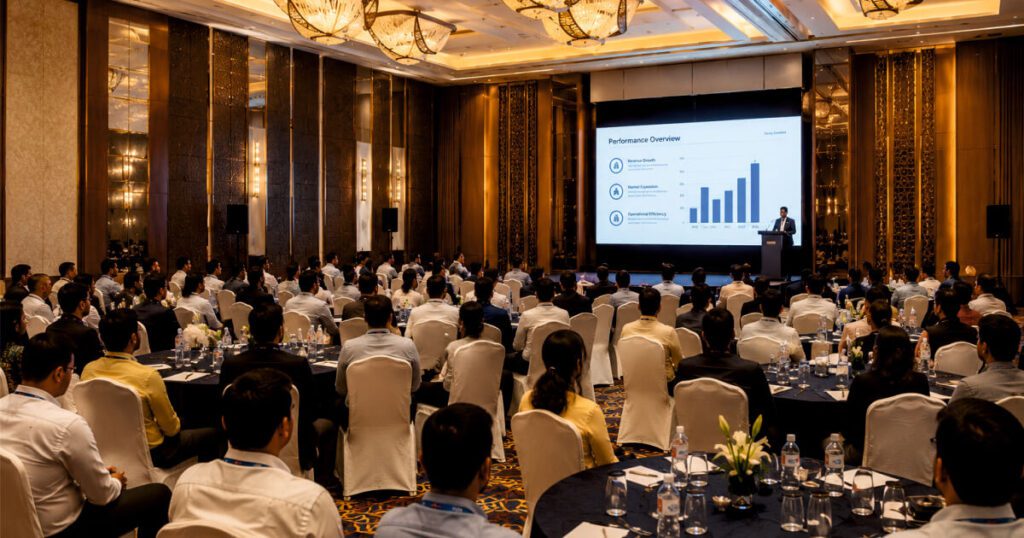
The live audience needs IMAG (image magnification) on the venue screens so they can see facial expressions during speeches. The recording audience needs cuts between wide shots, close-ups, and audience reactions. A single static camera serves neither well. Three to four camera positions, a vision mixer, and a director calling cuts is the minimum for a serious townhall.
3. Q&A logistics that actually work
Most townhalls allocate the last 30 to 45 minutes to Q&A. The execution of this segment is what employees actually remember from the event — whether their voices were heard, whether questions were curated honestly, whether leadership answered openly or deflected.
The production setup for Q&A matters more than most teams think. Roving microphone handlers need a plan for moving quickly between far ends of the auditorium. Question submission systems (live mic, app-based, written cards) each create different audience dynamics. Pre-curated questions versus open mic is a strategic decision, but the production execution must match whichever the leadership chose.
4. Run-of-show calibration to leadership style
Annual townhalls have a structure: CEO opening, business unit updates, financial summary, strategic priorities, Q&A. The standard structure works. What varies is the leadership style.
Some CEOs prefer tight, time-boxed segments — ten minutes per business head, no exceptions. Others prefer conversation-driven sections that can run long. Some want planned content with cues; others want flexibility to respond to the room. The run-of-show must be designed for the specific leadership team running the event, not a templated format applied uniformly.
5. The transitions between segments
The most common failure point in a 2-3 hour townhall is the transitions. A CEO finishes a speech. Silence. Slide change. Audio gap. Next speaker fumbles for the microphone. Two minutes of energy drain.
Transitions feel like small details until they happen ten times in an event. Cumulatively, they determine whether the townhall feels professionally produced or amateur. The production team’s job is to engineer transitions so they take seconds, not minutes — pre-cued slides, microphone hand-offs choreographed in advance, walk-on music ready, vision mixer instructed
What the HR / Communications Team Should Own — And What They Should Hand Off
In our work with HR and Corporate Communications teams across BFSI, technology, manufacturing, pharmaceutical, and shipping clients, the most productive role split is consistent.
The HR / Comms team owns:
- Strategic narrative and key messages for the year
- Business unit updates and which leaders speak
- Recognition or awards segments and their content
- Q&A approach decisions (pre-curated, open mic, app-based)
- Internal stakeholder alignment
- Final approval of run-of-show and content flow
The production partner owns:
- Venue technical assessment and production design
- Sound engineering, camera setup, vision mixing
- IT coordination and security clearance management
- Recording, streaming, and post-event distribution
- Run-of-show writing and transition choreography
- Vendor management and on-ground execution
- Backup contingencies for technical or human failure
HR and Comms teams that try to manage the production layer themselves are typically distracted from the strategic content layer they should be focused on. Production teams that try to make content decisions overstep the role they are equipped for.
A Realistic Production Timeline for an Annual Townhall
For a 500-2,000 attendee annual townhall in a corporate auditorium, the realistic preparation timeline is two to three weeks of focused work — assuming the HR team has already finalised content direction and speaker lineup.
Two to three weeks before:
- Production partner conducts technical site visit at the office venue
- IT and security coordination begins (access protocols, network requirements)
- Production design draft — sound, AV, camera positions, stage layout
- Recording and distribution format confirmed with the client’s IT team
One to two weeks before:
- Production design approved
- Vendor onboarding and equipment lineup confirmed
- Run-of-show first draft based on speaker confirmations
- Q&A approach finalised with HR / Comms team
The week of the event:
- Setup begins 12-24 hours before the event in the venue
- Full technical rehearsal with sound, cameras, vision mixing
- Walk-through with key leadership speakers if available
- Run-of-show locked, contingencies briefed
Event day:
- Production team on-site 4-6 hours before start time
- Final sound and visual checks before audience arrival
- Execution — sound, cameras, recording, transitions, Q&A handling
- Post-event recording delivery within 24-48 hours
For townhalls with shorter lead times, the timeline compresses but does not skip steps. Even a one-week sprint requires the same sequence in a tighter rhythm.
Frequently Asked Questions
How long does it take to plan an annual corporate townhall?
For a 500-2,000 attendee annual townhall in a corporate auditorium, the realistic production preparation timeline is two to three weeks of focused work, assuming HR has finalised content direction and speaker lineup. Shorter timelines are possible for experienced production teams but compress every step.
What is the most common production mistake in corporate townhalls?
The most common failure is uneven or unclear audio. Employees seated far from the stage cannot hear leadership speeches at the same clarity as those near the front. This is a sound design challenge requiring engineering before the first microphone test — not a microphone choice. Stage spectacle does not compensate for inaudible audio.
Should annual townhalls be recorded?
Yes, in nearly all cases. Most companies have employees in regional offices, on shift work, or working remotely who cannot attend the live event. Professional multi-camera recording with vision mixing, paired with internal distribution through the company’s intranet or video platform, has become standard for serious annual townhalls.
How should Q&A be handled in a large townhall?
Q&A approach should match the company culture and leadership preference. Pre-curated questions allow controlled messaging but feel scripted. Open mic with roving microphone handlers creates authentic engagement but requires production discipline for speed and audio coverage. App-based question submission with leadership selecting which to answer is a middle path. Each requires different production setup — the choice should be made before production design begins.
Can a corporate office auditorium handle 1,500-2,000 attendees for a townhall?
Yes, if the space was designed for that capacity and the production team works within its constraints. The challenges are typically sound coverage across the full audience, IT and security clearance for additional production equipment, and recording quality matching what a hotel venue would deliver. None of these are unsolvable, but they require production planning specific to the venue.
How This Fits Our Work
MRG Evennts produces corporate events across formats — from intimate launches to large all-employee celebrations to senior leadership offsites and annual townhalls. What stays consistent is calibration of production to the format and the room.
For deeper context on related event types:
- How We Work With Corporate Clients
- Family Annual Day Guide for Corporate Mumbai
- Conference Management in Mumbai
Or browse our recent case studies for events delivered across BFSI, FMCG, technology, pharma, shipping, and media sectors.
Planning Your Next Annual Townhall?
Share your brief — venue, attendee count, date range, and what you want the townhall to achieve. A proposal lands in your inbox within 48 hours.
48-hour proposal response • 15+ years • 2,000+ events delivered